I had no intention of watching the sunrise at Yushan. I decided to descend the entire 2,200 meters of elevation to Chiayi that very day. I’d once descended 1,600 meters from a pass around 2,800 meters high in Wyoming, USA, all the way down to the town at the base, but 2,200 meters was definitely a first for me.
The descent down the mountain trail that took a full day to climb began. “Whoo, Yah-ho-ho!!” Downhill cycling is something special. I couldn’t help but let out a cry.
However, the wind-cutting speed rapidly lowered my perceived temperature. Even though it was November in the highlands of Alishan, this was Taiwan, and the temperature was around 15°C. Yet, within just five minutes, I found myself pulling on my windbreaker.
玉山のご来光を拝むつもりはありません。この日のうちに嘉義まで標高差2,200mを下ることにしました。アメリカのワイオミングで2,800mほどの峠から一気に1,600mをふもとの街まで下ったことはありますが、さすがに2,200mともなると始めてです。
丸一日がかりで上った山道の下りが始まりました。「ヒュー、ヤッフォッフォッー!!」自転車でのダウンヒルは格別です。思わず声が出ます。
ところが風切るスピードで体感温度がどんどん下がります。11月の高地の阿里山とはいってもそこは台湾、気温は15度ほどあるのですが、ものの5分もしないうちにウインドブレーカーを着込むこと始末です。
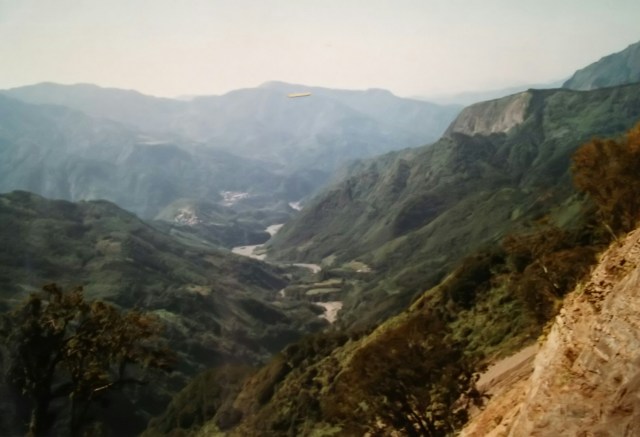
I descended through these mountainous areas all the way to Chiayi. In the end, it turned into a stop-and-go downhill ride until I reached the lower elevations.
こんな山間を嘉義まで下ります。結局、高度の下がる途中まで、休み休みのダウンヒルになりました。

This is the Wu Feng Temple on the right side of Route 18, just before Chiayi. There is a legend about Wu Feng.
Wu Feng was an official during the Qing Dynasty(1616-1912) and also served as an interpreter for the Tsou tribe, the indigenous people around Alishan. The Tsou tribe had a headhunting custom. Wanting to stop it, Wu Feng offered his own life as the final head, without the Tsou tribe realizing it. Shocked by Wu Feng’s decapitation, the Tsou later blamed a plague that struck their tribe on Wu Feng’s curse, and thus abandoned headhunting thereafter.
In Japan, the term “indigenous people” (先住民) is often used instead of “aboriginal people” (原住民). However, in Taiwan, “aboriginal people” (原住民) refers to those who are no longer living. Hereafter, following Taiwanese usage, the term “aboriginal people” (原住民) will be used.
The Taiwan Governor-General’s Office during the later Japanese colonial period latched onto this story of the Han Chinese Wu Feng. They renovated the dilapidated shrine dedicated to Wu Feng into a magnificent temple.
They then included the story of Wu Feng’s “sacrificing his life for righteousness” in the public school textbooks for Taiwanese people during the Japanese colonial period. Subsequently, the legend similarly appeared in Japanese elementary school textbooks and in Korean public school textbooks for Koreans.
However, it was not included in textbooks for educational institutions targeting indigenous peoples, including the Tsou tribe. Today, this sequence of events is pointed out as evidence that the Japanese government of the time may have intentionally used the legend of the Han Chinese figure Wu Feng in elementary education across Taiwan, Japan, and Korea with a specific purpose.
After World War II(1941-45), the Kuomintang government similarly treated Wu Feng’s legend as a story of “sacrificing one’s life for righteousness” in textbooks. The difference was that the Tsou tribe, an indigenous group, also began learning from these same textbooks. This led to questions arising among the Tsou tribe about the Wu Feng legend. They claimed that within their community, it was passed down that “Wu Feng was killed because he was an unscrupulous merchant.” In other words, Wu Feng’s biography was merely a one-sided account from the Han Chinese perspective. Moreover, it implanted the impression that not only the indigenous peoples who retained headhunting customs, but all indigenous peoples, were cruel and barbaric.
Around 1983, just when I visited Taiwan, a movement began among indigenous peoples and students to remove Wu Feng’s biography from textbooks and to reexamine the legend itself.
In 1988, the Wu Feng statue in front of Chiayi Station was toppled. The following year, 1989, the surrounding area’s name “Wu Feng Township” was changed to “Alishan Township.” The Wu Feng legend was then removed from textbooks.
On the other hand, the “Wu Feng Temple” still stands today. When I took this photo, many elementary school students were visiting it.
これは嘉義の手前、18号線の右手の「呉鳳廟」です。呉鳳(ウーファン)には伝説があります。
呉鳳は清朝時代の役人で、阿里山周辺の原住民ツオウ族との通訳でもありました。ツオウ族には首狩りの習慣があり、それをなんとか止めさせたい呉鳳は、最後の首狩りとしてツオウ族に悟られないように自らの命を差し出しました。呉鳳の首をはねたことに驚いたツオウ族は後に部族に疫病が流行ったのも呉鳳のタタリだとして、以後首狩りを止めたそうです。
日本では原住民より先住民という言葉を用いる場合が多いのですが、台湾で先住民というとすでにいなくなった人を指します。以下、ここでは台湾にならって原住民という言葉を使います。
この漢人の呉鳳の話に飛びついた(?)のが後の日本統治時代の台湾総督府でした。荒れていた呉鳳を祀った祠(ほこら)を立派な廟堂へと改装したのです。
そして日本統治時代の台湾人を対象とした公学校の教科書に呉鳳の「殺身成仁」の話として取り上げたのです。その後、同様に日本でも尋常小学校、朝鮮では朝鮮人を対象とした普通学校の教科書に載ることになります。ただし、ツオウ族を始めその他の原住民を対象とした教育所の教科書には載せませんでした。
今では、この一連の流れを時の日本政府が漢人の呉鳳の伝説をもって台湾、日本そして朝鮮における初等教育にある種の意図をもって行っていたのではないかと指摘されています。
第二次大戦後、国民党政府も同じように呉鳳の伝説を「捨身取義」として教科書で扱います。違っていたのは原住民のツオウ族も同じ教科書で学ぶようになったことです。するとツオウ族から呉鳳の伝説について疑問の声が上がるようになりました。ツオウ族の間では「呉鳳は悪徳商人だから殺した」と言い伝えられているというのです。つまり呉鳳伝記は漢人側から一方的にみた話にすぎないということです。おまけに首狩りの習慣が残る原住民だけでなくその他の原住民までも残忍、野蛮という印象を植え付けてしまったのです。
ちょうど私が台湾を訪れた1983年頃から呉鳳伝記の教科書からの削除や伝説自体を見直す運動が原住民や学生の間で始まりました。
1988年に嘉義駅前の呉鳳像は倒され、翌1989年に周辺の地名「呉鳳郷」が「阿里山郷」に変更されました。そして呉鳳伝記は教科書で扱われなくなります。
一方、今でも「呉鳳廟」はそのまま残されています。この写真を撮った時も多くの小学生が見学していました。
 My Life with Bicycles