From the Wu Feng Temple, I head into the city of Chiayi, then begin heading south again.
「呉鳳廟」から嘉義の街へ、そして再び南下を始めます。
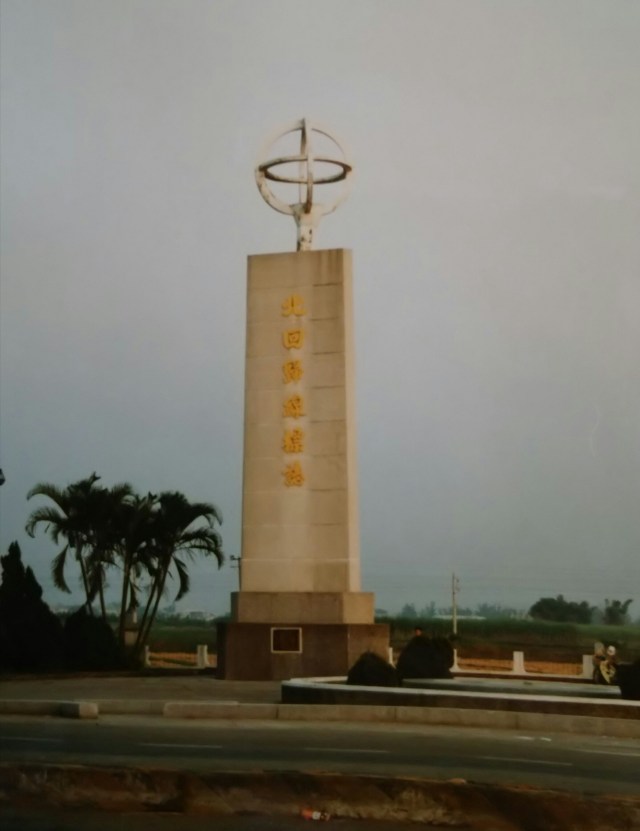
This is the Tropic of Cancer (23°27′ N) marker tower, located about 3 kilometers south of Chiayi city. Beyond this point lies the tropical zone. Since the tower was first erected in the early 20th century, it has been rebuilt each time it collapsed due to disasters, making this the fifth iteration. However, it’s unclear which generation this particular tower represents. That night, I camped in a field before reaching Tainan.
I departed a bit early at 7 AM and arrived in Tainan by mid-morning. As mentioned earlier, the parents of Ms. C, a Taiwanese colleague from my work in Japan, live in Tainan. I had been trying to call him in Tokyo since the previous day to find out the exact location, but couldn’t get through. Deciding to call again that evening, I first set out to explore the streets of Tainan.
Taiwan became known in Europe after a Portuguese navigator discovered it in 1590 as “Ilha Formosa” (Beautiful Island). Of course, indigenous peoples had lived on the island for ages, but other inhabitants were merely a few drifting Han Chinese settlers and some of the Wokou pirates active mainly in the East China Sea.
By the 17th century, the Dutch advanced into present-day Tainan, while the Spanish moved into Keelung in the north. Later, the Dutch expelled the Spanish from Taiwan. To begin full-scale development of the island, the Dutch East India Company recruited settlers from mainland China. Tainan was the center of this effort, making it Taiwan’s first developed and historically significant city.
これは嘉義の街から3キロほど南にある「北回帰線(北緯23度27分)標示塔」です。ここから先は熱帯地方になります。20世紀初めに標示塔が立てられて以来、災害などで倒壊するたびに立て直されて現在5代目になっていますが、この塔は何代目かわかりません。この日は台南を前に畑の中で野宿となりました。
ちょっと早く朝7時に出発、午前中に台南へ到着しました。前述したように台南には日本での仕事の同僚、台湾人のCさんのご両親が住んでいます。その場所を知るべく前日から東京のCさんに電話をしているのですが連絡とれずにいました。夜にまた電話をすることにして、まずは台南の街を散策することにしました。
台湾は1590年にポルトガル船の航海士が “Ilha Formosa(イラフォルモッサ=美しい島)” として発見してからヨーロッパで知られるようになりました。もちろん原住民は昔から台湾島で暮らしていましたが、その他の住人は流れ着くようにして渡った少数の漢人入植者や東シナ海を中心に暗躍していた倭寇の一部にすぎませんでした。
17世紀になるとオランダが現在の台南へ、スペインが北の基隆(ジーロン)へと進出します。その後オランダはスペインを台湾から追い払い、オランダ東インド会社が本格的に島の開発を始めるために中国本土からの入植希望者を募りことになります。その中心が台南で、つまり台南は台湾で最初に拓けた歴史ある街なのです。
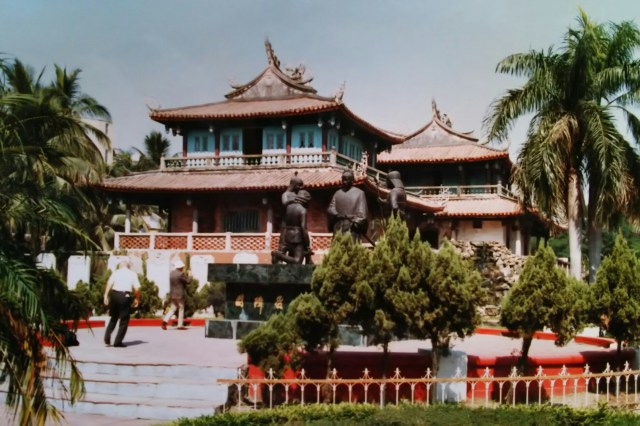
This is Chikan Tower. It stands behind an elementary school about 500-600 meters along Chenggong Road, which runs west from Tainan Station. Originally a Dutch fortress called Provintia, it was converted into the administrative seat of Taiwan, the “Eastern Capital of the Heavenly Prefecture,” by Zheng Chenggong after his victory over the Dutch forces. Though later completely destroyed by an earthquake, it was rebuilt in Chinese style utilizing the remaining foundations.
“Eastern Capital” was the name Koxinga gave to Taiwan. At that time, the island, still called “Beautiful Island” by the Portuguese, had no specific name.
In the 17th century, the Ming Dynasty in China referred to Taiwan as “Eastern Barbarian” (Dong Fan). It seems likely that the “Eastern” part was adopted.
Furthermore, in China at that time, the indigenous people called Tainan and Anping to its north “Dai Uan,” which was transcribed into Chinese characters as “大員” (Dai Yuan). There was also the indigenous word “Taoyuan,” meaning “visitor,” and several theories exist about the origin of Taiwan’s name. In any case, it seems certain that the indigenous language was the source of “Taiwan.”
Zheng Chenggong’s father was Chinese and his mother Japanese. Chenggong himself grew up in Nagasaki’s Hirado until he went to China at age seven. After arriving in China, he fought as a loyalist of the Ming dynasty, which had been overthrown by the Qing, but was forced to retreat. He then fought the Dutch to establish Taiwan as a base for counterattack, making the first fortress he captured, Zeelandia in Anping, his own stronghold. Though it lasted only twenty-odd years before defeat by the Qing, it marked the first time Taiwan had a semblance of a state.
The statue in the center of the photo depicts Dutchmen petitioning Zheng Chenggong for peace. In Taiwan, Chenggong is revered as a hero.
これは「赤崁楼(チーカンロウ)」です。台南駅から西へのびる成功路を5、6百m行った小学校の裏手にあります。もともとはオランダが建てたプロヴィンシアというお城でしたが、オランダ軍に勝利した鄭成功が台湾の行政機関「東都承天府」としました。その後地震で全壊しまいましたが、残った土台を活かして中国風に建て替えられました。
東都とは成功が名付けた台湾を意味する言葉です。このころはまだポルトガル人が「美しい島」呼んだ島に特定の名はありませんでした。
17世紀、中国の明では台湾を「東蕃」と呼んでおり、その「東」をとったような気がします。
また、当時の中国では原住民が台南やその北の安平を「Dai Uan」と呼ぶのを漢字の「大員」にあてていました。ほかにも原住民が来訪者を意味する言葉「Taoyuan」があり、台湾の名前の由来には諸説あります。いずれにせよ原住民の言葉が「台湾」由来となったのは間違いないようです。
鄭成功の父親は中国人で母親は日本人です。成功も7才で中国へ渡るまで長崎の平戸で育ちました。中国に渡った成功は清によって滅ぼされた明の遺臣として戦いましたが撤退を余儀なくされます。そして反撃の拠点を台湾とすべくオランダと戦い、最初に攻め落とした安平のゼーランディア城を成功自身の居城としました。清朝に破れるまでの二十数年間でしたが、初めて台湾に国家らしい形ができたのです。
写真の中央の像はオランダ人が成功に和議を願い出ているところです。鄭成功は台湾では英雄として扱われています。
 My Life with Bicycles