It’s been 15 days since I left Taipei, and after touring Taiwan, I’ve returned to Taipei once again.
[I did promise I’d come back when I left, after all.] The person I made that promise to was the old man at the hotel where I stayed in Taipei. He was the front desk guy who kept calling me, persistently asking, “How about tonight, young girl?” It was just past noon, but I checked into that Pan American Hotel.
[I’d better get this out of the way first.] To the old man who greeted me with a cheerful (?) smile, I said, “I won’t be staying tonight,” as a substitute for a greeting.
I called the airline from the hotel and booked a flight to Narita three days later. All that was left was sightseeing in Taipei. Starting the next day, I wandered all over Taipei City. I’ll post the photos all at once.
台北を出発して15日目、台湾を一回りして再び台北へ戻ってきました。
[出発する時に戻ってくるって約束したからなぁ]約束した相手は私が台北で泊まったホテルのオヤジさんです。あのしつこく「コンヤ、オジョウサンイカガ?」と電話をかけてきたフロントのオヤジさんです。昼を過ぎたばかりですがそのパン・アメリカンホテルにチェックインしました。
[ここはひとまず先制しとくか]ニコニコと嬉しそう(?)に出迎えるオヤジさんに「コンヤ、オジョウサンイラナイヨ」と挨拶がわりにひと言。
ホテルから航空会社に電話をして三日後の成田便の予約をとりました。あとは台北観光を残すのみです。翌日から台北市内をアチコチ回ってみました。まとめて写真を載せます。
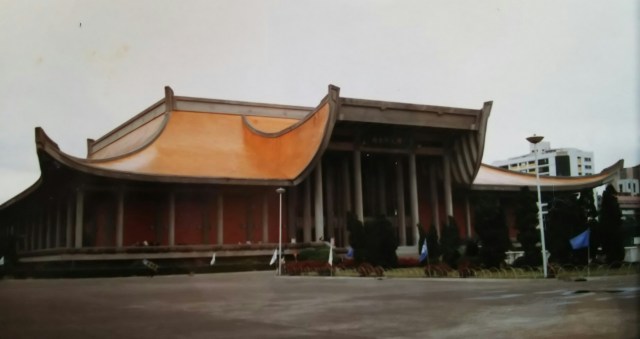
This is the “National Dr. Sun Yat-sen Memorial Hall,” located southeast of Taipei. “Father of the Nation” refers to Sun Yat-sen, who founded the Republic of China following the fall of the Qing Dynasty. In Taiwan, he is known as Sun Zhongshan, the “Father of the Nation.” This memorial hall was planned to commemorate the 100th anniversary of Sun Yat-sen’s birth and was completed in 1972. Upon entering the massive 30-meter-tall building, visitors are greeted by a large, approximately 6-meter-tall seated statue of Sun Yat-sen. Situated in a corner of the spacious Zhongshan Park, it offers a serene escape from the bustling surroundings.
台北の南東に位置する「国父紀念館(グォフーシェグアン)」です。国父とは清朝後に中華民国を建国した孫文のことです。台湾では建国の父として孫中山の名で知られています。この紀念館は孫文の生誕100年を祝って計画され、1972年に完成しました。高さ30mの大きな建物に入ると、これまた6mほどの大きな孫文の座像が出迎えてくれます。広い中山公園の一角にあり、周囲の賑やかさを忘れさせてくれます。
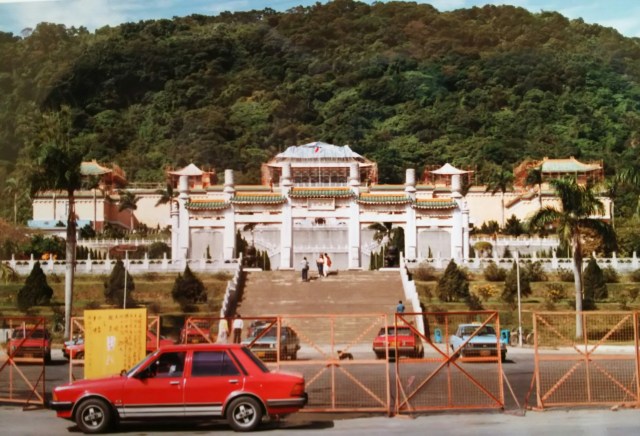
This is the famous “National Palace Museum.” It is located about 6 or 7 kilometers north of downtown Taipei. The museum displays treasures from the Song, Yuan, Ming, and Qing dynasties.
Originally, these treasures were housed in Beijing, but due to the Japanese invasion, they were moved to Shanghai and Nanjing, and later scattered across various parts of China as the Japanese army advanced southward. After the war, they were returned to Nanjing and Beijing, but during the subsequent civil war between the Communist Party and the Kuomintang, the treasures were transported to Taiwan by the Kuomintang. The collection, which was said to number 620,000 items at the time, has since grown to 650,000 items, boasting one of the largest collections in the world. There is also a National Palace Museum in Beijing that displays the treasures left behind there.
有名な「故宮博物院(グォリーグーボーウーユエン)」です。台北の中心から北へ6、7キロとちょっと離れています。宋、元、明、清と各王朝の宝物が展示されています。もともと宝物は北京にあったのですが、日本の侵略により上海や南京へ、さらに日本軍の南進により中国各地へと分散されました。大戦後に再び南京や北京へ戻されましたが、その後の共産党と国民党の内戦時に宝物は国民党によって今度は台湾へ運び出されました。当時、62万点といわれた展示物は今では65万点と増えており世界最大級の展字数を誇っています。尚、北京にも残された宝物を展示する故宮博物院があります。
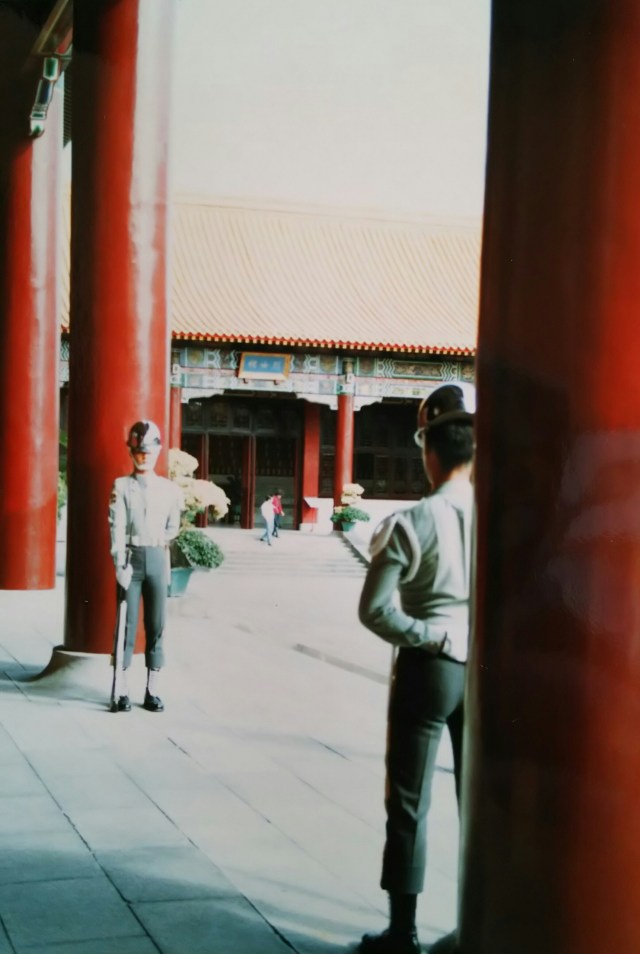
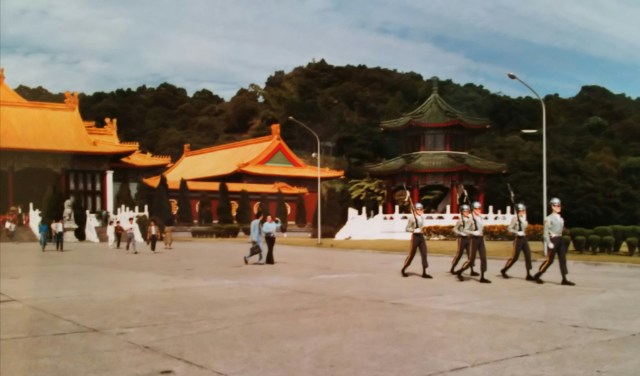
This is the Martyrs’ Shrine (Zhonglie Ci), located on the opposite bank of the Keelung River, which flows north of Taipei. During the Japanese colonial period, the Taiwan Gokoku Shrine originally stood here, but it was rebuilt into the current Martyrs’ Shrine in 1969. It enshrines the heroic spirits who died in the Xinhai Revolution in 1911-12, the founding of the Republic of China in 1912, and the War of Resistance Against Japan(137-45).
This facility is under military administration, and soldiers from the Army, Navy, and Air Force take turns serving as honor guards. Their uniforms are distinct: the Army wears dark green, the Navy wears white in summer and black in winter, and the Air Force wears blue.
Tourists gather to watch the changing of the guard, which takes place every hour. There are a total of four guards—two at the main gate and two at the main hall. They are known for standing completely still until their shift ends. The photo above shows the guards in front of the main hall, and the photo below shows the changing of the guard in progress. A leading soldier walks at the front of the line. Perhaps the helmets perched slightly on their heads and the short pants are measures to combat the heat. Judging by the color of their uniforms, the guards on this day appear to be from the Army.
台北の北を流れる基隆河の対岸にある「忠烈祠(ジョンリエツー)」です。日本統治期、ここにはもともと台湾護国神社がありましたが1969年に現在の忠烈祠に建て替えられました。辛亥革命、中華民国建国や抗日の戦いで亡くなった英霊を祀っています。
この施設は軍の管理下にあり、陸海空三軍の兵士が交代で衛兵勤務についています。制服は陸軍が深緑、海軍は夏は白・冬は黒、空軍は青と別れており区別がつきます。
一時間ごとの衛兵交代を目当てに観光客が集まってきます。衛兵は大門と大殿に各2名の計4名です。彼らは交代まで微動だもしないことで知られています。上の写真は大殿前の衛兵、下の写真は交代中のようすです。先頭に引率の兵が付きます。ちょこっと頭に乗ったヘルメットと短いズボンは暑さ対策でしょうか。この日の衛兵は軍服の色からして陸軍のようです。
 My Life with Bicycles