On the way back to the hotel, I was thinking about where and how many times I’d seen the changing of the guard. At Buckingham Palace in London, I saw the guards but missed the changing ceremony because the timing didn’t work out. So, I’ve actually been able to properly witness it three times: at Syntagma Square in Athens, at Amalienborg Palace in Copenhagen, and at the Martyrs’ Shrine in Taipei. In London and Copenhagen, the guards protect the palaces, while in Athens, they guard the “Tomb of the Unknown Soldier” in the square, which is similar to the Martyrs’ Shrine in Taipei.
In Athens, a small group marches several times a day. When I saw it, the march was a bit disorganized, but their traditional uniforms, which resembled skirts, left a strong impression. In Copenhagen, they marched once at noon, divided into groups of many people. Their long hats reminded me of toy soldiers. The changing of the guard at the Martyrs’ Shrine involves fewer soldiers, but it happens every hour, making it the most frequent.
[That soldier didn’t move at all just now. That’s impressive.] Twenty minutes of the hour are spent on the change of guard, but they remain motionless for the remaining 40 minutes.
[Come to think of it, Mr. C once said, “Young Japanese men are wimpy and not manly at all.”] I recalled what Ms. C, a Taiwanese man, had told me: “In Taiwan, men join the military at age 19 and undergo nearly two years of military training, returning as strong, capable men.” It seems that military training is widely recognized as a rite of passage into manhood.
At that time, Taiwan had a mandatory military service system, requiring men to enlist for 22 months. After martial law was lifted, the term was shortened to one year. Then, in 2012, it was reduced to just four months of military training, effectively abolishing the mandatory military service system.
ホテルへと戻る道すがら、私はこれまで衛兵交代をどこで何回見たか思い出していました。ロンドンのバッキンガム宮殿は衛兵は見たものの交代式の時間が合わずダメでした。ちゃんと見学できたのはアテネのシンタグマ広場、コペンハーゲンのアマリエンボー宮殿、そして台北の忠烈祠で計3回ということになります。ロンドンとコペンハーゲンは宮殿の警護、アテネの衛兵は広場にある「無名戦士の碑」の警護ということで台北の忠烈祠と似ています。
アテネは一日数回、数人で行進します。私が見た時はちょっとバラバラの行進でしたが、スカートのような民族衣装が印象的でした。コペンハーゲンは正午に1回、多人数でグループに別れて行進していました。長い帽子がおもちゃの兵隊を彷彿させました。忠烈祠の衛兵交代は人数は少ないものの一時間毎と回数は最多です。
[さっきの兵士は全く動かなかったな。大したもんだよ]一時間のうち20分は交代に要する時間ですが、残りの40分じっとしたままなのです。
[そういえばCさんが「日本の若い男性は、ナヨナヨしてて男らしくない」って言ってたっけ]私は台湾人のCさんが話していた「台湾の男性は19才になると軍隊に入って二年近く軍事訓練を受けて、たくましくなって戻ってくるんです」そんな話を思い出していました。どうやら軍事訓練は自他共に認める大人の男性へのステップのようです。
当時の台湾は兵役制度があり、22ヶ月間軍へ入隊する義務がありました。戒厳令解除後は期間が一年と短縮されます。そして2012年、4ヶ月の軍事教練のみとなり、実質兵役制度が廃止されました。
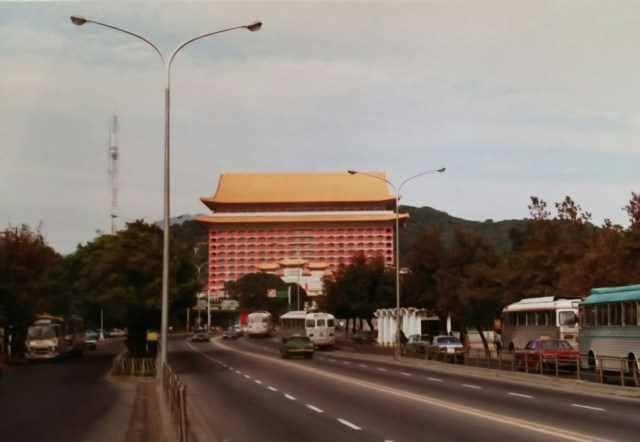
This is the world-famous “Grand Hotel,” photographed on my way back to the hotel from the Martyrs’ Shrine. It was originally built as a state guesthouse on the site of a former Taiwanese shrine. A fire broke out on the 12th floor in 1995, but the hotel reopened three years later.
忠烈祠からホテルへ戻る途中で撮った世界的に有名な「圓山大飯店(ユェンシャンダーファンディエン)」です。台湾神社跡にもともと迎賓館として建てられたものです。1995年に12階から出火しましたが3年後に営業を再開しました。
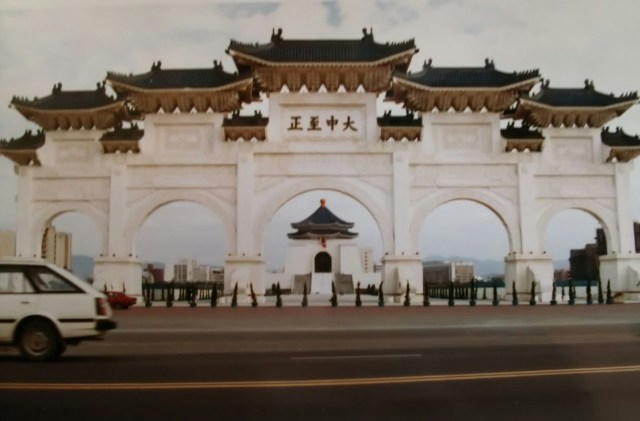
The first place I visited that day was the Chiang Kai-shek Memorial Hall, located in Zhongzheng Park south of Taipei Main Station. Visible beyond the central arch is the memorial hall, completed in 1980 to honor Chiang Kai-shek, who passed away in 1975.
When the Democratic Progressive Party took power, it renamed the hall the “Democracy Memorial Hall.” At the same time, the inscription “Zhengzhi Zhongda” (meaning “Uprightness Leads to Greatness”) at the entrance was changed to “Freedom Plaza,” reflecting the party’s liberal ideology. When the Kuomintang returned to power in 2009, the name was restored to Chiang Kai-shek Memorial Hall. However, the “Freedom Plaza” sign displayed at the entrance remains in place to this day.
この日最初に向かったのは台北駅の南の中正公園内にある「中正紀念堂(ズョンズュージーネイルタン)」です。中央のアーチの奥に見えるのがが1975年に亡くなった蒋介石を記念して1980年に完成した紀念堂です。
民進党が政権を握ると「民主紀念堂」と改名しました。同時に入り口の「正至中大(読みは大中至正)」を右流れの「自由廣塲」に変えました。2009年に国民党が政権に返り咲くと再び中正紀念堂に戻しました。ただし、入口に掲げられた自由廣塲は今でもそのままにされています。

This is the current “Governor-General’s Office of the Republic of China.” It is located northwest of the Chiang Kai-shek Memorial Hall, closer to Taipei Main Station. Originally built in 1919 during the Japanese colonial period, it was known as the “Taiwan Governor-General’s Office.” Although the interior was destroyed by U.S. air raids, it was renovated by the Kuomintang government and has served as the Governor-General’s Office of the Republic of China ever since. The contrast between the red brick and white marble is striking, though it doesn’t photograph well. Among the successive Japanese governors-general, there were some who grew fond of Taiwan and left instructions for their families to “build a grave for me in Taiwan after I die”; apparently, such graves actually exist there.
現在の「中華民国総督府」です。中正紀念堂の北西、より台北駅の近くになります。もともとは1919年、日本統治期に建てられた「台湾総督府」です。米軍の爆撃により内部が焼失しましたが、国民党政権によって内部が改装され、中華民国総督府として現在に至っています。赤いレンガと白い大理石のコントラストが目を引くのですが写真の写りがよくありません。歴代の日本人総督の中には台湾が気に入り、家族に「私が死んだら台湾に墓を建ててくれ」といい残した人もおり、実際に墓があるそうです。
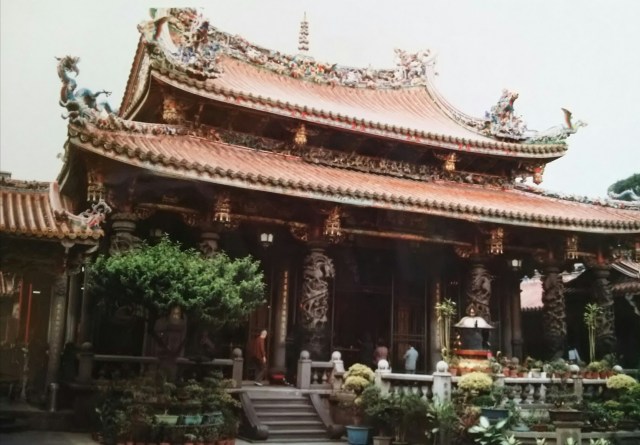
The last place I visited was Longshan Temple, located in the Wanhua District, about one kilometer southwest of the Governor-General’s Office. Wanhua is the oldest district in Taipei, and its streets are lined with shops that evoke the atmosphere of a traditional working-class neighborhood, such as tool shops, herbal medicine stores, and antique shops.
It is customary to enter the temple through the Dragon Gate on the right and exit through the Tiger Gate on the left; much like the Dragon and Tiger Pagodas I visited in Kaohsiung, this seems to be based on the auspicious symbolism associated with the entrance and exit.
最後に訪ねたのが総督府から南西へ1キロほどの萬華区にある「龍山寺(ロンシャンスー)」です。萬華区は台北でもっとも古い地区で通りには道具屋、薬草局、骨董屋など下町を感じさせる店が並んでいます。お寺へは右の龍門から入り左の虎門から出ると決められており、私が高雄で訪ねた龍虎塔と同じく入り口と出口の縁起をかついでいるようです。
 This dragon ornament is also the name of the temple and is considered the most auspicious.
Longshan Temple was built in 1738 as a branch of a temple in Quanzhou, Fujian Province, and is the oldest temple in Taipei. While the principal deity is Guanyin, the temple also enshrines deities from Taoism and Confucianism, as well as gods associated with academics, safe childbirth, romance, and just about everything else—making it something of a “one-stop shop for gods and Buddhas.”
お寺の名前でもあり、一番縁起がよいとされる龍の飾りです。
龍山寺は福建省泉州のお寺の分寺として1738年に建てられ、台北で一番古いお寺です。ご本尊は観音様ですか、他にも道教、儒教を始め学問や安産、恋愛などありとあらゆる神様が祀られており「何でも屋の神様、仏様」みたいです。
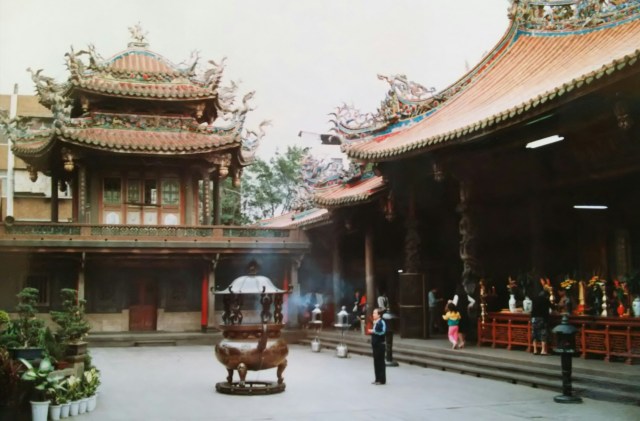
Although there aren’t many visitors today, I’ve heard that on the 1st and 15th of each lunar month—known as “Bai Bai” (meaning “to pay respects”)—many locals and tourists come to visit.
この日の参拝者はこの程度ですが「拜拜(お参りの意)」と呼ばれる旧暦の1日と15日には多くの市民や観光客が参拝に訪れるそうです。
 My Life with Bicycles