Hello, I’d like to book the earliest flight to Taipei. I already have a ticket.
Yes. Please tell me your name.
On my first day in Hong Kong, I had trouble with my luggage—my bike bag and other items didn’t arrive—so I waited at the hotel for them. In the end, I only went out for dinner. From the second day onward, I took the ferry to Hong Kong Island, cycled to Kowloon City, and otherwise just wandered around Hong Kong without any particular destination. It was a huge difference from Paris, where I’d been cycling around every day.
[I’ve felt Hong Kong’s energy enough; maybe it’s time to move on.] With that thought, I booked a ticket to Taipei. When I gave my name,
“You’re the customer who purchased the ticket in Paris, correct? Please hold while I verify.”
[Yeah, faster is definitely better.] After a moment,
“There’s availability on the Taipei flight tomorrow at 4 PM?”
“Tomorrow? Then I’ll take that one.”
I got a surprisingly early booking. All that remained was heading to my final destination, Taiwan.
The flight from Hong Kong to Taiwan’s northern Chiang Kai-shek International Airport took just over an hour, and customs cleared smoothly.
October 27th (Thursday), arrival in Taiwan. 1 NT$(New Taiwan Dollar)≒¥6. NT$ and yuan are the same currency.
Chiang Kai-shek International Airport would later be renamed Taoyuan International Airport. “Chiang Kai-shek” is the birth name of the Republic of China’s first president.
「もしもし、台北行きの一番早い便をお願いしたいんですけど。チケットは持ってます」
「はい。それではお名前をお願いします」
香港初日は輪行袋など荷物の積み残しというトラブルがあり、その到着をホテルで待機していました。結局、外出したのは夕食の時だけです。二日目以降もフェリーで香港島へ、自転車で九龍城へ、それ以外はどこへ行くでもなく香港の街をブラブラしていました。毎日自転車で走り回っていたパリとはえらい違いです。
[香港のパワーは十分に感じたし、そろそろ移動するかな]そんな思いで台北行きの予約をしていました。私が名前を告げると、
「パリでチケットをご購入のお客さまですね。確認しますので、しばらくお待ちください」
[やっぱ早い方がいいな]しばらくして、
「明日の午後4時の台北行きに空きがありますが?」
「明日ですか。じゃあ、それでお願いします」
思いのほか早い予約が取れました。後は最後の訪問地台湾へ向かうだけです。
香港から台湾北部の中正国際機場までは1時間ちょい、税関もスムーズに終了。
10月27日(木)、台湾入国。1NT$(元)=約6円。NT$(ニュー台湾ドル)と元は同じことです。
後に中正国際機場は現在の桃園国際機場に改称されます。中正は中華民国初代総統の蒋介石の本名です。
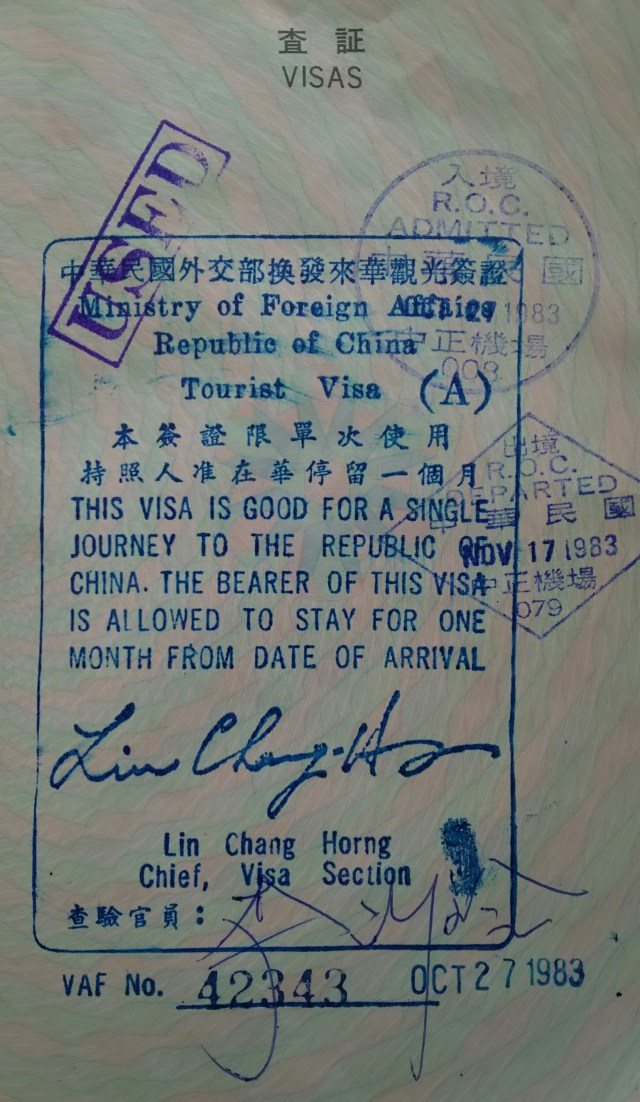
This is a Taiwan visa. Back then, even tourists needed a visa for Taiwan.
I decided to book a hotel in Taipei City at the airport information desk.
Normally, I’d assemble my bicycle at the airport and just start riding, but I figured I’d treat myself a little at the end of the trip. That said, I booked the cheapest hotel (US$10-16 per night).
I took the limousine bus from Chiang Kai-shek Airport to Taipei. Partway through, the bus started traveling on an elevated road.
[Ah, this looks like…] Dense clusters of houses, TV antennas perched on each roof, utility poles lining the road. It was exactly the same scenery I saw from the train window on the Chuo Line during my commute. [It’s so similar to Tokyo…] Even though I was about to return home, Tokyo suddenly came to mind.
Returning from overseas always makes me notice anew how many utility poles Japan has. Currently, Taipei’s overhead power line removal rate is among the highest in Asia, reaching 95%. In Japan, however, progress on removing overhead lines is slow, both nationwide and even in Tokyo specifically. Given Japan’s frequent natural disasters, some argue overhead lines are better for faster recovery.
Two years ago in November, there was a road collapse accident in Fukuoka. Many overseas media outlets reported on the speed of the recovery.
Apparently, if the power lines had been buried underground, the restoration wouldn’t have been that quick. On the other hand, in Europe, where urban aesthetics and beauty are prioritized, power lines and such have been buried underground for a long time. It’s even said that this approach is more resilient to disasters. What do you think?
これは台湾のビザです。当時の台湾は観光でもビザが必要でした。
空港内の案内所で台北市内のホテルの予約をすることにしました。いつもなら空港で自転車を組み立て、そのまま走り出すのですが、旅の最後にちょっと贅沢をということです。とはいうものの予約をしたのは一番安いホテル(1泊10~16米$)です。
中正機場から台北へ、リムジンバスを利用しての移動です。バスは途中から高架道路を走り出しました。
[あッ、これって……]密集する家々、その各家々の屋根に立つテレビのアンテナ、道路沿いに並ぶ電柱。私が通勤に利用していた中央線の車窓から見る風景と同じでした。[似てるなぁ、東京に]もうすぐ帰るというのに急に東京を思い出しました。
海外から帰国すると日本の電柱の多さに改めて気づかされます。現在、台北の無電柱化率はアジアで1、2の95%まで進んでいます。日本では全国的にも、また東京に限っても無電柱化がなかなか進みません。何かと自然災害の多い日本、早い復旧には電柱の方がよいともいわれています。
2年前の11月、福岡で道路陥没事故がありました。復旧の速さを多くの海外メディアが配信していました。もし電線が地下に埋設されていたら、あれほど早く復旧しなかったそうです。一方、街の景観、美観を重視するヨーロッパでは古くから電線などを地下に埋設しています。むしろその方が災害に強いともいわれています。どうなんでしょうか。
 My Life with Bicycles