After passing Guishan Island and leaving the coastline behind, I turned west and rejoined Route 9. [Alright, once I get over the mountain, it’s Taipei.] I’d been riding on flat roads from Suao to Yilan for the first time in a while, but the climb began here. Once, twice… after seven or eight repeated switchbacks on the steep ascent, the slope finally leveled off.
I’d crossed one mountain, but the pass was still ahead, and it was already starting to get dark. It was time to find a place to camp. I found a spot along the river, off the main road, where I could pitch my tent, but there was a house on the opposite bank. [I’d better ask for permission. It wouldn’t be good if they thought I was suspicious.] I decided to visit the house and ask if it was okay to camp there.
A man who looked to be in his 50s came out. I started by saying, “Ni hao.” Then, I showed him the self-introduction and the request to camp by the river that I had mentioned earlier, hoping we could communicate in writing. The man smiled and, to my surprise, replied to my introduction in Japanese. He spoke Japanese, albeit brokenly.
Whenever I couldn’t communicate in English or Japanese while traveling in Taiwan, I would rely on writing things down. Since we share the same Chinese character culture, I’d always managed to get by with written communication when I was in a bind.
This time, too, the man answered me using written notes and broken Japanese. Furthermore, as it was getting dark, he told me, “There’s a better spot,” and personally guided me to a wide open area upstream along the river.
亀山島をやり過ごし海岸線から離れ、西へと進路を変えると再び9号線に合流します。[よし、山を越えれば台北だ]蘇澳から宜蘭へと久しぶりに平坦な道を走りましたが、ここから上りが始まります。1回、2回…… 7、8回とつづら折りの急な上りを繰り返すとやっと緩やかな上りとなりました。
ひと山越えはしたものの峠はまだ先、すでに暗くなり始めています。そろそろ野宿の場所を探さなくてはなりません。幹線道路を外れた川沿いにテントを張れそうなスペースを見つけましたが、対岸に民家があります。[ひと言ことわりを入れておこう。不審がられてもマズイし]民家を訪ねて野宿をしてもオーケーか聞いてみることに。
出てきてくれたのは50代とおぼしきオジさん。まずは「ニイハオ」と挨拶。そして筆談にとあらかじめ手帳に書いた自己紹介と川沿いで野宿したいとの文言を見てもらいます。オジさんはニッコリすると何と自己紹介を日本語で返してきました。オジさんはカタコトですが日本語を話すのです。
台湾旅行中、英語や日本語でコミュニケーションが取れない場合、私は筆談をしていました。同じ漢字圏、困ったときは筆談でクリアしていたのです。
この時も筆談とカタコトの日本語でオジさんは答えてくれました。 さらに「もっといい場所があるから」と暗くなる中、川の上流の広い場所へとオジさん自ら案内してくれたのです。
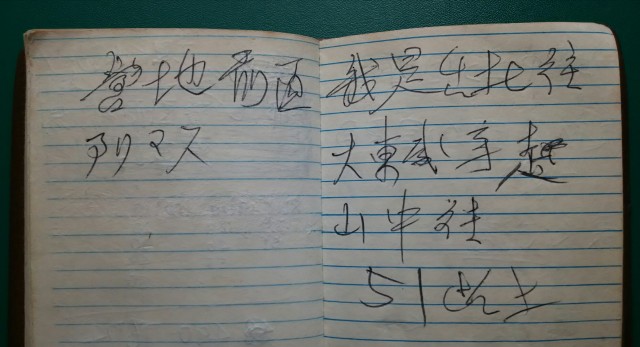
This is what the man wrote back then. “営地前直” means “right next to the campsite.” And there’s “アリマス” written in katakana. My diary entry for that day reads, “Mr. Liang Nanshan, thank you!!” Liang Nanshan is his name.
これがその時オジさんが書いてくれたものです。「営地前直」は「すぐそばに野営地」ということです。そして片仮名で「アリマス」とあります(?)。この日の日記には「梁 南山先生、謝謝!!」の記述。梁 南山はオジさんの名前です。
 My Life with Bicycles