Head straight south from Akan Tower and you’ll find a park. Turn left there and you’ll reach the Confucius Temple, dedicated to the great figure of the Spring and Autumn period, Confucius (Kǒngzǐ; c. 551 – c. 479 BCE).
While Confucius Temples can be found throughout Taiwan, this one, built over three hundred years ago, is the oldest in Taiwan and is considered the birthplace of Taiwanese Confucianism.
「赤崁楼」から南へまっすぐ行くと公園があります。そこを左に曲がると春秋時代の偉人、孔子を祀った「孔子廟」です。台湾のアチコチに「孔子廟」はありますが、三百年以上も前に建てられたこの「孔子廟」が台湾で一番古く、台湾儒教の発祥の地といわれています。
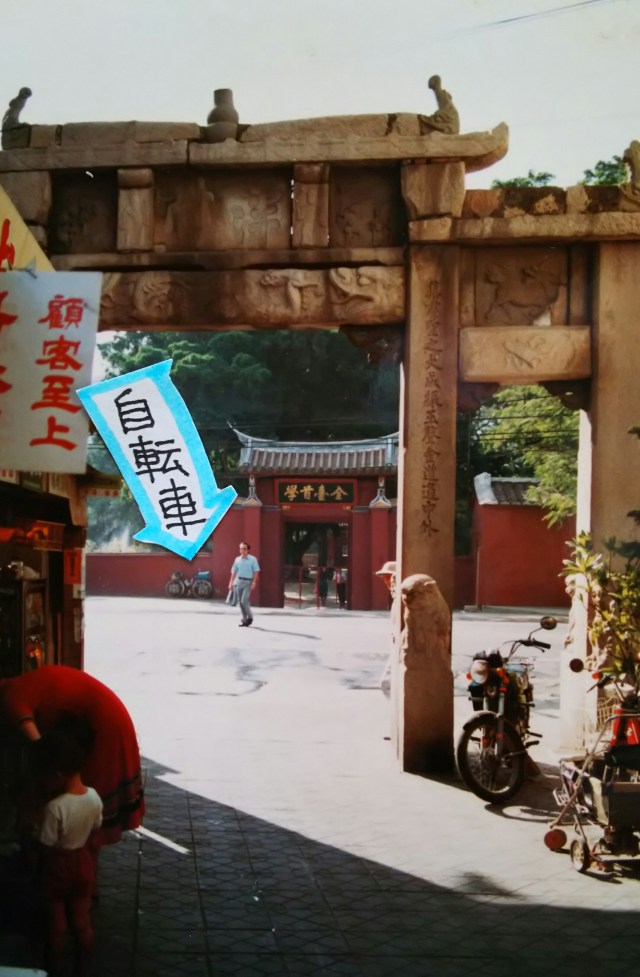
The entrance to the shrine is at the back. I took this photo from the approach (?) lined with souvenir shops.
奥が廟堂への入口です。土産物屋が並ぶ参道(?)側から撮ってみました。
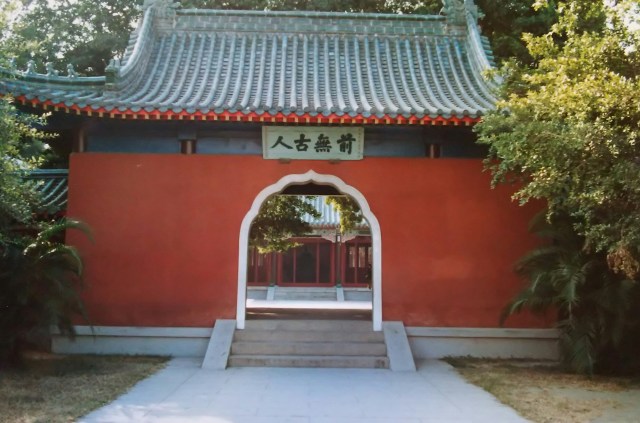
Heading southwest from the “Confucius Temple” along Kaishan Road, you’ll soon come to the Yanping Junwang Shrine, dedicated to Zheng Chenggong. Within the grounds is the Zheng Chenggong Museum, displaying artifacts related to his life. During the Japanese colonial period(1895-1945), this shrine was called Kaishan Shrine. That might explain why its architecture bears some resemblance to Japanese shrines.
That night, I decided to stay at a cheap inn near the station. One night for 300 NT dollars = about ¥1,800. It was my first inn since Taipei, six days ago.
After a quick bath and shave, feeling refreshed, I wandered the night streets. I turned off Zhongzheng Road onto a side street, browsing various stalls, and ended up having a late dinner at a street stall on Minzu Road on the way back.
The menu featured my favorite pork chop rice (排骨飯, paikōhan) and Tainan’s famous danzai noodles (但仔麺, danzui mian) with soup. The pork chop rice is basically a bowl of fried pork chops with bone, while the danzai noodles are a light, salty ramen broth made with shrimp stock.
Unfortunately, I couldn’t get in touch with Ms. C in Tokyo by phone last night, this morning, or since. So, I ended up leaving Tainan without greeting his parents. My next destination is the southernmost cape, Eluanbi.
About 50 kilometers from Tainan to Kaohsiung, roughly 10 kilometers before that in the Zuoying area, lies the tourist attraction Lotus Pond Lake. The photo shows the Dragon and Tiger Pagoda at Ciji Temple, which enshrines the god of medicine, located on the lake’s shore. Opposite the Dragon and Tiger Pagoda, to the left in this photo, is Ciji Temple. The vivid photo below is a postcard.
「孔子廟」から開山路を南西に行くと、すぐに鄭成功を祀る「延平郡王祠」があります。敷地内には成功にまつわる資料を展示した「鄭成功文物館」が併設されています。この「延平郡王祠」は日本統治期には「開山神社」と呼ばれていました。少し日本の神社らしい造りが見られたのはそのせいかも知れません。
この日は駅近くの安宿に泊まることにしました。1泊300元=約1,800円。宿は台北以来の6日ぶりです。
ひとっ風呂浴びて髭をそり、サッパリしたところで夜の街をブラブラ。中正路から横道に入り出店をアレコレひやかし、帰りに民族路の屋台で遅い晩飯となりました。
メニューは、私のお気に入りの排骨飯(パイコーハン)と台南名物の但仔麺(タンツーメン)にスープ。排骨飯は骨付き豚肉の唐揚げ丼、但仔麺は海老ダシの薄味塩ラーメンといったところでしょうか。
昨夜そして今朝とその後も東京のCさんと電話で連絡がとれず、残念ですがご両親に挨拶することなく台南を出発することになりました。次に目指すは最南端の岬、鵝鑾鼻(オールアンピー)です。
台南から高雄(カオシュン)まで約50キロ、その手前10キロほどの左営地区に観光名所、淡水湖の蓮池潭があります。写真はその湖の畔にある医の神を祀る慈濟宮「龍虎塔(ロンフーター)」です。「龍虎塔」の対面、この写真の左側に慈濟宮があります。下の鮮やかな写真は絵ハガキです。
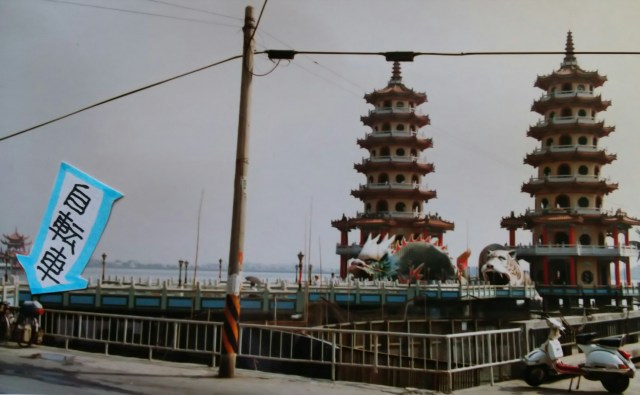

You can’t tell from the photo, but from the front of Ciji Temple, you cross a zigzag bridge five or six times before entering the large, open dragon’s mouth at the entrance. The bridge is zigzagged to prevent evil spirits, which can only move in straight lines, from approaching. Inside the dragon’s mouth, there are narrative-style murals painted on the walls. Emerging from the mural tunnel brings you to the entrance of the seven-story pagoda. The stairs only went partway up. Passing the second tower, you emerge from a tunnel painted with murals of tigers.
In China, the dragon is considered the most auspicious of the twelve zodiac animals, while the tiger is seen as the most inauspicious. Entering through the dragon’s mouth and exiting through the tiger’s is said to ward off evil spirits. I was told the murals in the dragon tunnel depict a story of filial piety, but I couldn’t quite make out the murals in the tiger tunnel.
Perhaps because it’s a temple, there was no admission fee. Instead, they accepted donations in lieu of an entrance fee. When you made a donation, they gave you a commemorative picture postcard. The photo is the postcard I received then.
Lotus Pond is long and narrow, stretching north to south for over a kilometer. True to its name, lotus flowers grow wild in several spots. Along the lakeshore, besides the Tzu Chi Temple, there were scattered temples and pagodas built up to the 20th century, including a Confucius Temple built at the end of the 17th century. It’s what you’d call a good luck spot today.
Kaohsiung is Taiwan’s second-largest city after Taipei. [I suppose there are sights to see, but whatever.] I wasn’t in a rush, but I decided to bypass Kaohsiung city proper. My diary entry for that day reads, “Emerged from the suburban factory belt and breathed a sigh of relief.” I was apparently overwhelmed by the city’s atmosphere.
写真ではわかりませんが、慈濟宮の前からジグザグの橋を五度、六度と曲がって入口の大きく空いた龍の口へ入ります。橋がジグザグになっているのは真っ直ぐにしか進めない魔物を寄せ付けないためだそうです。龍の口の中は何やら物語風の壁画が描かれています。壁画のトンネルを出ると七階建て塔の入口です。階段で上ることができるのは途中まででした。二つ目の塔をパスして、これまた壁画が描かれた虎のトンネルから出ます。
中国では十二支の中で一番縁起が良いのが龍で、反対に悪いのが虎だといわれています。龍の口から入って虎から出ることで邪気が払われるそうです。龍のトンネルの壁画は親孝行の話だと教えてもらいましたが、もう片方の虎のトンネルの壁画についてはよくわかりませんでした。
お寺だからでしょうか入場料はありません。そのかわりお布施がわりの寄付を受け付けていました。寄付を差し出すと記念の絵ハガキをくれます。写真がその時にもらった絵ハガキです。
蓮池潭は南北に細長く1キロ以上ありそうです。その名の通り所々に蓮が自生しています。湖畔には慈濟宮のほかにも17世紀末に建てられた孔子廟始め、寺院や塔など20世紀までに建てられた寺院や塔が点在していました。今でいうところの開運スポットです。
高雄は台北に次ぐ台湾第二の都市です。[見所もあるんだろうけどイイヤ]先を急ぐわけでもないのですが高雄の街をそのままスルーすることにしました。この日の日記には「郊外の工場群を抜け出てホッと一息」と書かれていました。街の雰囲気に圧倒されていたようです。
 My Life with Bicycles